

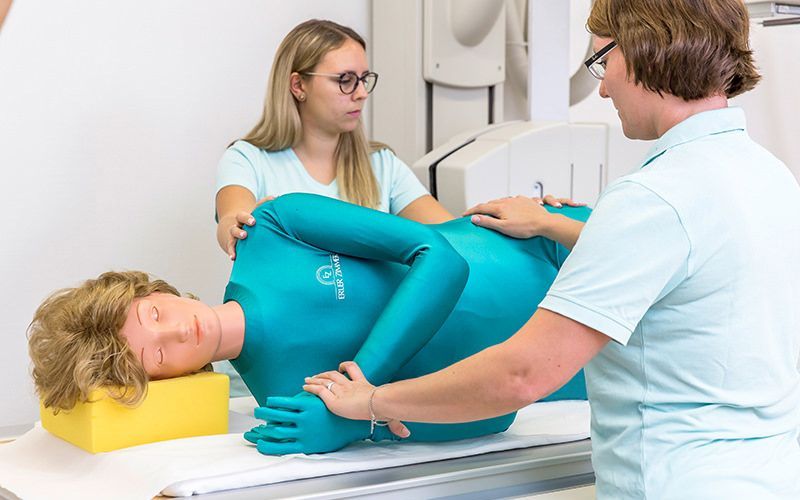
Simulation in Radiologic Tech Programs: Preparing Students for Modern Clinical Imaging
Imagine a World Where Every Graduate Is Clinic Ready on Day One
What if every radiologic technologist who walked into a clinical rotation already had:
- Confidence scanning real patients?
- Experience with a variety of modalities?
- A performance record showing competence before patient contact?
This isn’t an abstract ideal, it’s what strategic simulation training makes possible.
Why This Matters Now
Healthcare is rapidly evolving. Imaging workloads are growing. Employers expect graduates who can contribute from the first shift. Accrediting bodies are emphasizing competency over seat time. So the real question isn’t whether simulation matters, it’s: Are your simulation practices preparing students for the complexity of modern imaging or just helping them check boxes?
1 | Not All Simulation Is Created Equal: What Realistic Training Looks Like
Most radiology programs use some form of skills lab or demo machine. But high impact simulation is not just a static tool in a lab, it’s a bridge between theory and clinical judgement.
Ask yourself:
- Does your simulation replicate decision pressure or only technical tasks?
- Can learners practice pathology that they might never see during a short clinical rotation?
- Are you capturing performance data that informs remediation?
Beyond Technique: Functional Realism
Truly effective simulation includes:
- Targeted clinical scenarios (e.g., trauma + CT triage, contrast reactions)
- Integrated cognitive reasoning (not just positioning)
- Feedback loops that guide improvement, not just observation
This aligns with professional simulation education guidance, which increasingly emphasizes context, reflection, and measurable performance, not passive exposure.
2 | Simulation Tools That Make a Difference
Simulation isn’t a single thing, it’s a spectrum of tools and techniques that, when combined, create a realistic learning environment. Here’s how they fit together:
High Fidelity Procedural Simulators
These are not stand alone skill trainers, they shape how learners think about complex imaging workflows.
Examples:
- Interventional simulation platforms for guided biopsies or vascular studies
- Mobile simulation carts for in situ learning in real imaging environments
- Phantoms with acoustic and structural fidelity that mimic real human tissues
These tools help learners practice how they will work — not just what they should know.
Virtual & Screen Based Simulation
Don’t underestimate the impact of software:
- Protocol selection practice
- Anatomy recognition with layered cases
- Screenshot interpretation challenges
These modules allow repeated exposure to rare pathology and help calibrate learner judgement.
Role Play and Communication Scenarios
Simulation isn’t just about probes and positioning. Consider adding:
- Pre scan patient interviews
- Explaining procedures and risks
- Managing unexpected patient reactions
These softskill simulations improve professionalism and patient interaction, a big part of clinical success.
3 | What World Class Simulation Programs Do Differently
Let’s flip the lens: instead of what simulation is, consider: What do graduates from top programs do that others struggle with? Here’s what separates them:
They Don’t Wait for Clinical Opportunities, They Create Them
Rare cases, edge scenarios, nuanced anatomy — these don’t always show up on clinical rotations. High performing programs simulate them deliberately, so learners are familiar when they encounter them in practice.
They Couple Simulation with Structured Feedback
Post scan debriefs are not optional, they’re essential. The best programs train faculty to:
- Facilitate reflection rather than correct answers
- Capture assessment data
- Turn data into individualized learning plans
This practice turns simulation into performance improvement, not just practice.
They Align Simulation with Standards and Credentialing
Simulation that maps to:
- ARRT content domains
- Modality specific credentialing objectives
- JRCERT and program accreditation competencies
… builds confidence and credibility.
4 | Simulation as an Integrator Across Modalities and Professions
Today’s imaging teams are interdisciplinary. Simulation doesn’t need to be isolated to radiography:
- Interprofessional simulation (e.g., imaging + nursing + ED for trauma scans)
- Longitudinal competency tracking from basic X ray to advanced modalities
- Cross program shared scenarios (shared anatomy knowledge with sonography, MRI physics reinforcement, etc.)
This not only strengthens individual competence but builds team cognition, a critical workplace skill
5 | Debriefing: Where Learning Really Happens
Simulation without debriefing is entertainment, not transformation.
Effective faculty practice:
- Reflective questioning (“What were you thinking when you chose that protocol?”)
- Error analysis in context (not judgment)
- Immediate actionable feedback
- Goal setting for next performance
This is not just good teaching, it is simulation pedagogy grounded in clinical reasoning.
6 | What This Means for Program Leaders
If your goal is to graduate technologists who are:
- Clinically fluent
- Professionally prepared
- Ready to contribute on day one
- Reliable in high stakes environments
…then simulation must be strategically designed, deliberately implemented, and measured against outcomes.
Realistic simulation isn’t about luxury; it’s about educational ROI and readiness for real care environments.
Conclusion
Simulation in radiologic tech education has matured from an optional add on to a core pedagogical requirement. When simulation:
- Is aligned with real clinical workflows
- Reflects complex decision demands
- Provides structured feedback
- Is integrated across modalities
- Produces measurable outcomes
…then learners are not just trained, they are prepared.
Simulation stops being a training accessory and becomes a gateway to clinical performance
Want to build or enhance your radiology simulation training program with purposeful, outcome driven resources?
Download the Radiology Program Training Guide to access tools, templates, case examples, and implementation strategies designed for modern radiologic technology education.
References
- Simulation Education in Radiology — Weill Cornell Medicine Simulation Training Overview
- Simulation in Medical Imaging Education — Journal of Medical Imaging & Radiation Sciences
- Virtual & Interventional Simulation Tools for Radiologic Training — Mentice Interventional Platforms
- Structured Debriefing Practices in Healthcare Simulation — Healthcare Simulation Standards and Best Practice Literature
Disclaimer: This article was developed with the support of generative AI tools and reviewed by our team to ensure accuracy and relevance. It is intended for educational and informational purposes only and should not be considered medical advice, clinical guidance, or a substitute for professional training. Always consult relevant institutional policies, accrediting bodies, or medical professionals for clinical decisions.


