


The CARES 2025 Annual Report — And What That Means to Us
The 2025 CARES Annual Report reinforces something many people across CPR education, healthcare, EMS, and public health have been working to improve for years:
Training matters deeply.
But outcomes are influenced by more than training alone.
Over the last several decades, CPR education has expanded significantly.
Organizations train students. Healthcare systems invest in awareness. CPR organizations continue improving access, instruction, and community preparedness. Legislative and policy efforts — including the Cardiac Arrest Survival Act, the CARES Act, state CPR graduation requirements, and broader community emergency response initiatives — have also helped expand focus on preparedness and public response. Public reporting and survival tracking systems have improved our understanding of outcomes in ways that were not previously possible.
That progress matters.
The science supporting early CPR intervention is well established, and decades of work across emergency cardiovascular care, CPR education, public awareness, and community preparedness have helped expand both access to training and understanding of survival outcomes.
The CARES report reflects the work of countless EMS professionals, clinicians, educators, researchers, hospitals, dispatch systems, instructors, and organizations committed to improving survival from out-of-hospital cardiac arrest.
At the same time, the data also reinforces an uncomfortable reality:
There is still a meaningful gap between knowing CPR and actually stepping forward during a cardiac arrest event.
That gap is part of the reason The CPR Ready Generation™ was created.
The CPR Ready Generation™ is not a certification program or replacement for CPR instruction.
It is a student-led movement focused on the behavioral and cultural conditions that influence whether someone acts in a real emergency.
The movement exists to help strengthen:
- confidence
- readiness
- visibility
- peer influence
- willingness to intervene
- and long-term bystander culture
The goal is not to replace the existing CPR ecosystem.
It is to help strengthen the space between training and action.
From trained → to ready.
 Adapted from 2025 CARES Annual Report
THE DATA POINT THAT CHANGES THE CONVERSATION
42.5% of patients received bystander CPR.
One of the clearest data points in the report is this:
Only 42.5% of out-of-hospital cardiac arrest patients received bystander CPR before EMS arrival.
That means most patients still did not receive immediate intervention from someone nearby.
This matters because survival outcomes in sudden cardiac arrest are highly time-dependent.
The report also notes a median EMS response time of 7.6 minutes.
In many cardiac arrest situations, those minutes matter significantly for survival and neurological outcomes.
Which means:
The person standing nearby often becomes the critical link in the chain of survival.
For many people working in CPR education and emergency response, this is not a new realization.
But the CARES data reinforces how important the bystander still is.
That changes the question.
The challenge is no longer only:
“How do we train more people?”
It is also:
“How do we increase the likelihood that trained people actually step forward?”
That is not purely a knowledge problem.
It is also influenced by:
- confidence
- perceived expectations
- social norms
- fear of doing it wrong
- prior exposure to realistic scenarios
- and whether intervention feels psychologically normal
That distinction helps explain the behavioral gap The CPR Ready Generation™ is designed to address.
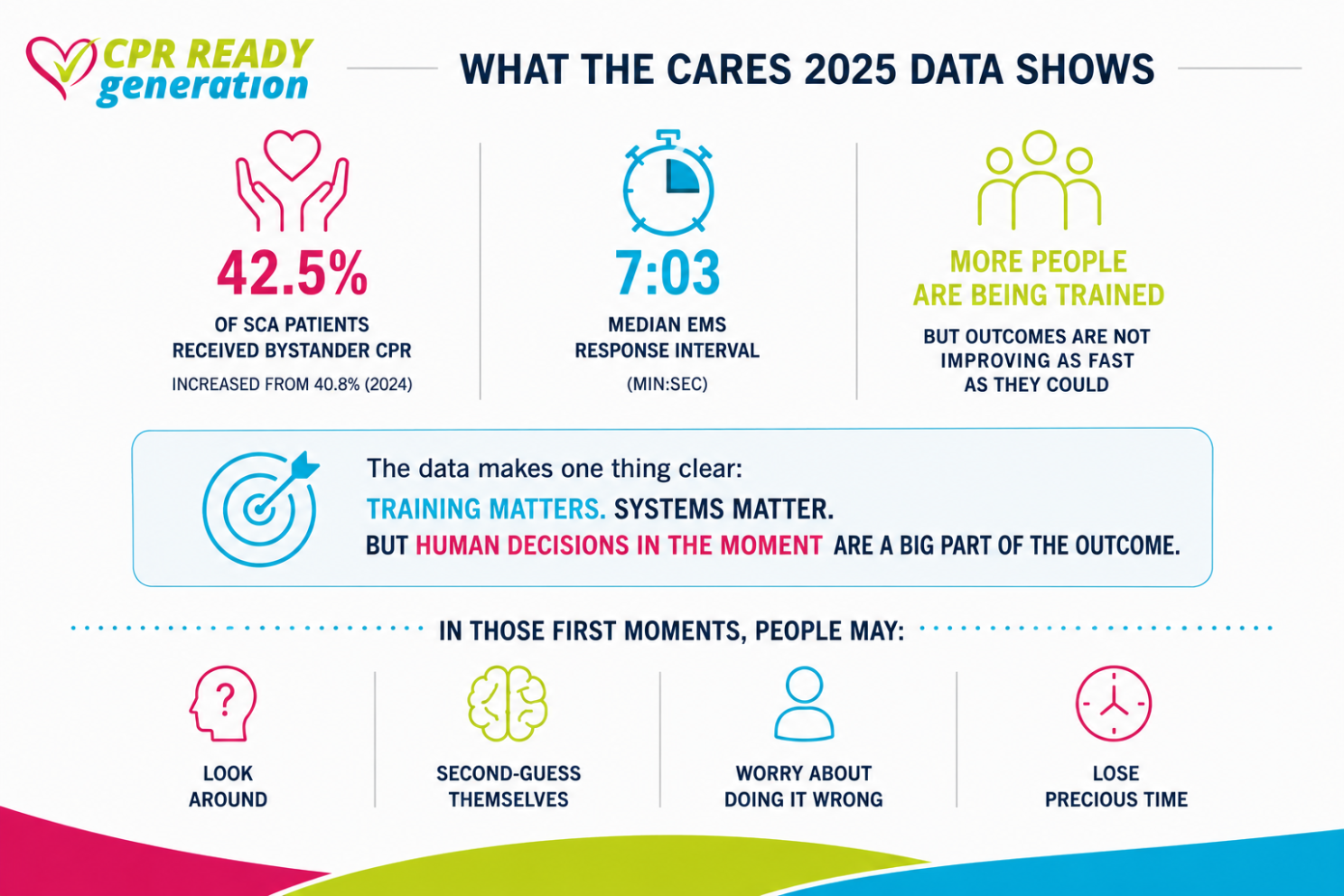
THE CPR READY GENERATION™ THESIS
Training exists. Hesitation still exists.
The CPR Ready Generation™ was built around a simple observation:
People can be trained and still hesitate.
Anyone who has spent time around CPR education has likely seen some version of this.
People care. They want to help.
But real emergencies are different from training environments.
The emotional and psychological realities of the moment still matter.
That observation aligns closely with the broader challenge reflected in the CARES outcomes data.
The movement focuses specifically on the space between: training → intervention.
Most preparedness systems focus appropriately on instruction.
The CPR Ready Generation™ focuses on what happens after instruction — particularly in public, peer-driven environments where behavior and identity are shaped.
That includes:
- confidence
- repetition
- visibility
- normalization
- peer influence
- public participation
- leadership
- and readiness identity
Awareness remains essential and has helped drive major progress in CPR education and preparedness. But awareness alone may not fully address the behavioral factors that influence whether someone intervenes during a real emergency.
The goal is helping readiness become something students see, model, talk about, and normalize with each other.
Because behavior is heavily influenced by culture.
And culture is often shaped peer-to-peer.
WHY STUDENTS MATTER
Students are uniquely positioned to influence long-term bystander behavior.
The CPR Ready Generation™ starts with students intentionally.
Part of that comes from a simple observation:
In schools and on campuses, students influence each other constantly.
They influence language. Behavior. Participation. What feels normal. What feels socially expected.
Preparedness is not separate from those dynamics.
Not because students are the only audience that matters.
But because they are one of the highest-leverage populations for long-term cultural change.
Students are:
- present in nearly every community
- socially connected in real time
- highly influenced by peer behavior
- still forming identity and social expectations
- capable of spreading norms quickly
The movement is built on a core belief:
Students do not just receive culture.
They influence it.
In schools and on campuses, behavior spreads socially.
What students repeatedly see from each other shapes:
- what feels acceptable
- what feels expected
- what feels socially normal
- and what they believe they themselves would do
That dynamic matters in preparedness.
Especially in high-pressure moments where hesitation, uncertainty, or fear can override technical knowledge.
That is why The CPR Ready Generation™ is designed to be:
- student-led
- social-first
- peer-driven
- visibility-focused
The strategy is rooted in a simple idea:
Students are more likely to engage with what they see other students talking about, participating in, and reinforcing publicly.
The movement is designed to make readiness more visible, more normalized, and more openly discussed among students.
Over time, that kind of repeated visibility and peer reinforcement can help reduce hesitation and strengthen confidence around intervention.
WHAT MAKES THE CPR READY GENERATION™ DIFFERENT
Most systems appropriately prioritize instruction and access.
The CPR Ready Generation™ focuses on readiness culture.
There are outstanding organizations advancing:
- CPR education
- certification
- AED deployment
- EMS systems
- awareness campaigns
- instructor development
- survival tracking
- healthcare preparedness
The CPR Ready Generation™ is not replacing that work.
It is designed to complement it.
The movement occupies a distinct but complementary space:
The culture layer between CPR training and real-world action.
Specifically, the movement focuses on:
Visibility-->
Making readiness socially visible.
Identity-->
Helping students see themselves as people who step forward.
Peer Influence-->
Using peer behavior to normalize intervention.
Repetition-->
Keeping readiness visible beyond a one-time training event.
Leadership-->
Turning preparedness into student ownership and participation.
Social Momentum-->
Using posting, tagging, recruiting, and visible participation to spread engagement.
This is what makes the movement structurally different from traditional awareness or compliance models.
The emphasis is not simply on exposure to information.
It is on repeated social reinforcement of readiness behavior over time.
THE INDUSTRY OPPORTUNITY
CPR infrastructure exists.
The behavioral and culture layer still has room to grow.
The CPR ecosystem has made major advances over the last several decades.
More people are exposed to CPR training. Awareness is significantly higher. More schools have CPR graduation requirements. AED access has expanded in many communities. Emergency response systems, public reporting, and survival tracking have improved dramatically.
That progress matters.
And much of it reflects years of work from educators, CPR organizations, healthcare systems, EMS leaders, researchers, advocates, policymakers, and community partners working toward the same goal:
Improving survival from sudden cardiac arrest.
At the same time, the CARES data reinforces that there is still important work to do around what happens in the minutes before EMS arrives.
Not because instruction is unimportant.
But because intervention behavior is influenced by more than instruction alone.
It is also influenced by:
- confidence
- visibility
- social norms
- peer behavior
- repetition
- realism
- and whether stepping forward feels psychologically normal
That is where The CPR Ready Generation™ is focused.
The movement is designed specifically around the idea that preparedness culture can be strengthened socially and peer-to-peer — especially among students.
There remains significant room for more large-scale, student-led efforts focused on:
- readiness identity
- public normalization of intervention
- peer-driven preparedness culture
- visible ongoing participation
- social reinforcement of action
This is not intended to replace or compete with the existing CPR ecosystem.
It is intended to help strengthen a connected layer that influences whether trained people actually feel ready to act.
The movement is intentionally designed to operate alongside schools, CPR organizations, healthcare systems, and existing preparedness infrastructure.
The goal is alignment.
Because improving outcomes will likely require not only strong instruction and systems — but also stronger cultures of readiness surrounding them.
WHY THIS MATTERS
At its core, this movement is about more than CPR technique.
It is about what happens in the few seconds when someone nearby realizes another person needs help.
Those moments are rarely calm or controlled.
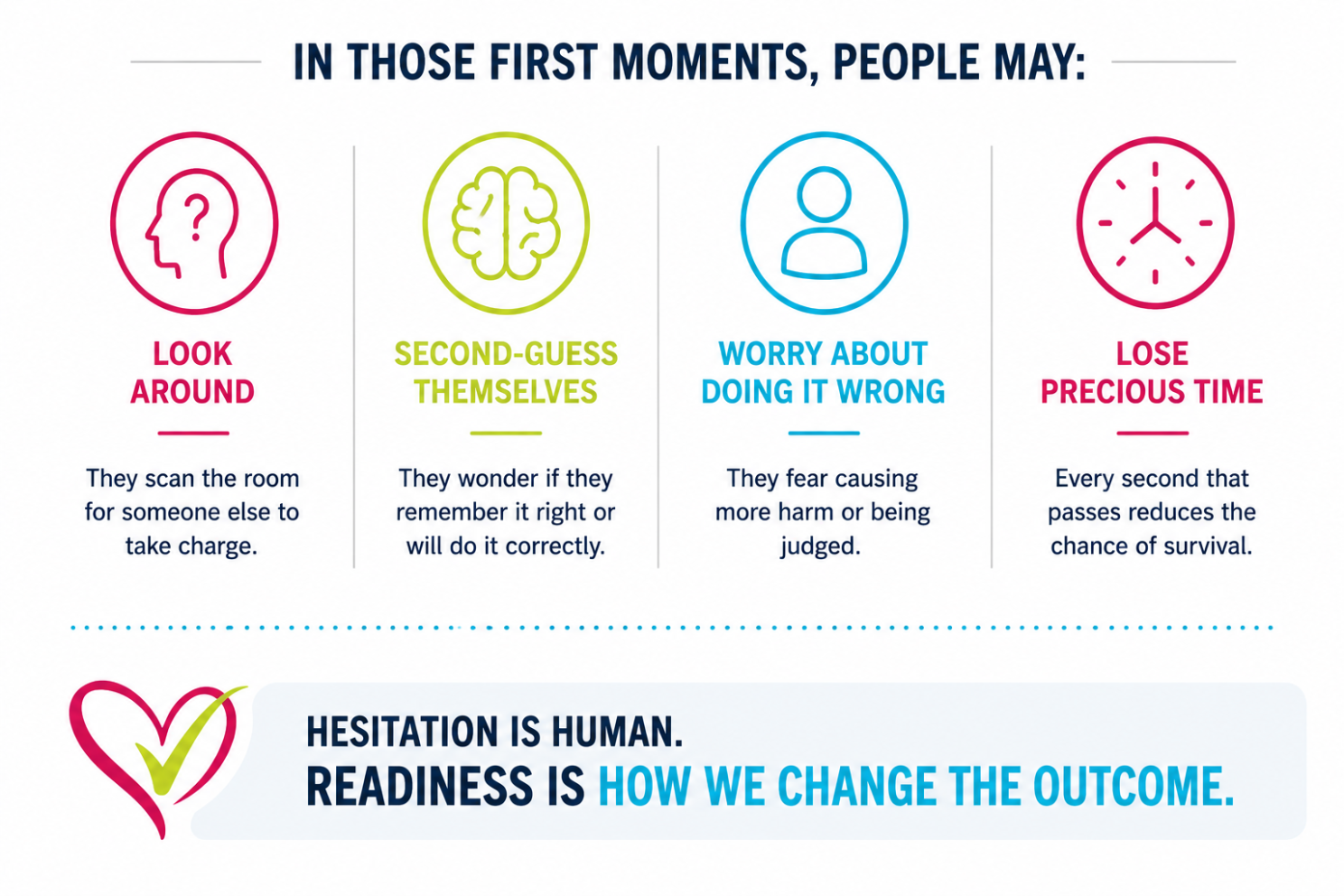
People look around. They hesitate. They second-guess themselves.
Sometimes they are unsure. Sometimes they are afraid of doing it wrong. Sometimes they simply freeze.
And in many cases, whether someone acts is influenced by far more than technical knowledge alone.
That reality matters.
Because survival in cardiac arrest often depends on what happens before professional help arrives.
It depends on whether someone nearby is willing to step forward.
That is part of what makes the CARES data so important.
The report reinforces an important reality:
Outcomes are not influenced only by systems and instruction.
They are also influenced by whether someone nearby is psychologically prepared to act.
That is why culture matters.
And this is one reason students matter so much in long-term preparedness outcomes.
Because the future bystander is sitting in today’s schools.
What students see from each other now will help shape what feels normal later.
Whether preparedness is visible. Whether stepping forward feels expected. Whether intervention feels like something ordinary people actually do.
That is the deeper goal behind The CPR Ready Generation™.
Not simply more awareness.
But helping build a culture where readiness becomes more visible, more talked about, and more socially reinforced over time.
THE ROLE OF SCHOOLS AND STUDENT LEADERS
Schools are one of the few environments capable of influencing an entire generation at scale.
Nearly every future bystander passes through a school, campus, team, club, or student organization.
That makes schools important enabling environments for long-term culture formation.
But The CPR Ready Generation™ is intentionally not school-led.
It is student-led.
Schools create the environment.
Students create the culture.
The role of the school is to support, enable, and reinforce participation.
The role of students is to drive visibility, influence peer behavior, and normalize readiness socially.
That distinction matters.
This movement is built on the understanding that large-scale behavioral change among young people spreads primarily peer-to-peer.
Especially in highly social environments like schools and campuses.
What students repeatedly see from each other influences:
- what feels socially normal
- what feels expected
- what feels acceptable
- and what they believe they themselves would do
That is why student leadership sits at the center of this movement.
Not as symbolic participation.
As a central mechanism for participation, visibility, reinforcement, and culture formation.
Student leaders help:
- normalize intervention behavior
- create visibility around preparedness
- recruit peers into participation
- organize activations and posting waves
- reinforce readiness socially
- model confidence publicly
- and build momentum across schools and campuses
The movement is intentionally structured around how participation and peer influence actually spread inside schools and campuses.
[Student participation and reinforcement loop]
Students post. Students recruit. Students model behavior. Students reinforce participation.
Over time, readiness becomes more than instruction.
It becomes identity.
And identity is often what influences action in high-pressure moments.
THE ROLE OF SPONSORS AND PARTNERS
The CPR Ready Generation™ is designed to work alongside the broader CPR ecosystem.
Sponsors and partners help support:
- student leadership development
- school activations
- readiness visibility campaigns
- ambassador programs
- peer engagement systems
- social participation initiatives
- campus and community involvement
This creates an opportunity for healthcare organizations, CPR organizations, schools, and sponsors to support something broader than awareness alone:
A long-term culture of readiness.
THE CORE IDEA
The CARES report does not suggest CPR education has failed.
In many ways, the report reflects decades of meaningful progress across CPR education, emergency response systems, public awareness, research, legislation, and community preparedness.
But the data also reinforces something important:
The next major challenge is not only instructional.
It is behavioral.
Training matters.
Access matters.
Awareness matters.
But whether someone intervenes in a real emergency is also influenced by:
- confidence
- visibility
- identity
- perceived expectations
- social reinforcement
- and culture
That is the layer The CPR Ready Generation™ is designed to help strengthen.
The movement is built around a simple but important idea:
Readiness becomes more powerful when it becomes visible.
When students see peers talking openly about preparedness, participating publicly, reinforcing intervention behavior, and identifying themselves as people willing to step forward, something begins to change.
Preparedness stops feeling abstract.
It becomes social.
It becomes normalized.
And over time, it becomes part of identity.
That is why this movement is intentionally student-led.
Not because students replace professional systems.
But because they influence culture at scale.
The CARES data reinforces how important the bystander still is in survival outcomes.
The CPR Ready Generation™ exists to help influence what future bystander behavior looks like.
Not through fear.
Not through obligation.
But through visibility, peer influence, leadership, and social reinforcement.
The long-term goal is simple:
Help build a generation that is more likely to step forward when the moment comes.
And help make readiness feel socially normal before that moment ever happens.
CONCLUSION
The CARES data reinforces something important:
The role of the bystander is still incredibly important.
Even with decades of progress in CPR education, emergency response systems, legislation, public awareness, and preparedness infrastructure, survival outcomes are still deeply influenced by whether someone nearby is willing and prepared to act.
That is the space The CPR Ready Generation™ is focused on.
Not replacing instruction.
Not replacing CPR organizations.
Not replacing schools or emergency response systems.
But helping strengthen the behavioral and cultural conditions surrounding intervention.
The movement is intentionally student-led because students influence culture in ways institutions alone cannot.
What students make visible and reinforce with each other shapes behavior over time.
Especially in environments where peer influence is constant and identity is still forming.
The CPR Ready Generation™ was created to help strengthen those dynamics around readiness.
Through visibility. Through peer influence. Through leadership. Through students openly modeling what readiness can look like.
The long-term goal is simple:
Help build a generation that is more likely to step forward when someone needs help.
And help make readiness feel socially normal long before that moment arrives.
The CPR Ready Generation™ is a student-led culture movement designed to help strengthen the space between CPR training and real-world action.
From trained → to ready.

SOURCES
CARES 2025 Annual Report CARES National Out-of-Hospital Cardiac Arrest Registry Data Median EMS response interval and bystander CPR statistics referenced from the 2025 CARES Annual Report.


