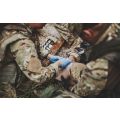

The First 10 Minutes of a Mass Casualty Incident: What Actually Determines Survival?
A Strategic Guide for Law Enforcement and Multi-Agency Response Leaders
When a mass casualty incident (MCI) occurs — whether an active shooter event, large-scale vehicle collision, public venue attack, or complex multi-victim trauma scene — survival is often determined long before the first patient reaches a hospital.
It is determined in the first 10 minutes.
For law enforcement leaders, training commanders, emergency managers, and first responders, this reality has direct operational implications. The agencies that perform well during a mass casualty incident are rarely the ones with the longest written plans. They are the ones who have engineered performance into the first critical minutes.
This article examines what modern research, national data, and recent guideline updates reveal about early survival determinants in mass casualty response — and why multi-agency planning must shift from policy compliance to measurable execution.
Scene Safety Comes First, But It Cannot Become a Delay Variable
Before hemorrhage control, before CPR, before triage, there is scene safety.
In active violence and complex mass casualty incidents, law enforcement’s first responsibility is threat identification and mitigation. No medical intervention can occur if responders become casualties.
However, modern multi-agency doctrine, including Rescue Task Force (RTF) models and Tactical Emergency Casualty Care (TECC) principles, recognizes a critical balance: scene safety and life-saving intervention must evolve together, not sequentially when conditions allow.
In many incidents, this means:
- Rapid threat suppression or containment
- Establishment of warm zones
- Controlled entry of rescue personnel
- Immediate hemorrhage control in permissive environments
After-action analyses of major incidents repeatedly show that delays are often less about lack of capability and more about uncertainty: Is the scene secure? Who declares it? When can EMS move forward? Who initiates warm zone care? Clear doctrine prevents hesitation.
High-performing agencies predefine:
- Authority for warm zone designation
- Integration triggers for Rescue Task Force activation
- Law enforcement expectations for immediate life-saving interventions
- Communication protocols between patrol supervisors and fire/EMS command
Scene safety is non-negotiable. But clarity around evolving safety conditions prevents unnecessary delay in life-saving care.
In the first 10 minutes of a mass casualty incident, safety and stabilization are parallel objectives — not competing ones.
The Pre-EMS Window: Law Enforcement Owns the First Minutes
In most active violence or complex trauma events, law enforcement arrives before fire/EMS can safely enter. Federal reviews of active shooter incidents consistently show that police intervention typically occurs within minutes of onset, while EMS staging may occur until scenes are secured.
During that window:
- Victims may be exsanguinating from extremity trauma.
- Cardiac arrest may occur secondary to hypoxia or shock.
- Airway compromise may progress unnoticed.
- Bystanders may attempt uncoordinated aid.
The first 5–10 minutes are often law enforcement–driven.
According to the American Heart Association (2025 Guidelines for CPR and ECC), survival from out-of-hospital cardiac arrest decreases by approximately 7–10% for every minute without CPR and defibrillation. Brain injury can begin within 4–6 minutes without oxygen.
Trauma data from the American College of Surgeons Committee on Trauma (ACS-COT) continue to reinforce that uncontrolled hemorrhage remains one of the leading causes of preventable death in trauma — frequently occurring prior to hospital arrival.
In opioid-associated respiratory emergencies, the CDC reports that overdose deaths remain above 100,000 annually in the United States (2024 provisional data), with hypoxia preceding cardiac arrest. The operational takeaway is clear: Mass casualty survival begins before EMS arrival.
Why Many Mass Casualty Plans Fail Under Stress
Most agencies have a Mass Casualty Incident plan. Many have participated in tabletop exercises. Some have conducted full-scale drills.
Yet after-action reports from real-world incidents often reveal recurring challenges:
- Delayed hemorrhage control
- Confusion regarding medical leadership roles
- Unclear casualty collection points
- Communication breakdown between agencies
- Delayed activation of rescue task force (RTF) concepts
- Limited interoperability between law enforcement and EMS doctrine
Plans fail not because they are poorly written, but because they are not stress-tested.
The 2025 American Heart Association systems-of-care framework emphasizes structured team roles, measurable performance metrics, and continuous quality improvement in resuscitation systems. The same principles apply to mass casualty planning.
Without measurable benchmarks and joint rehearsal under realistic conditions, performance variability increases. And in mass casualty events, variability costs lives.
The Four Performance Variables That Determine Early MCI Survival
Across trauma research, cardiac arrest registries (including CARES 2024 data), and resuscitation science, four early variables repeatedly correlate with survival outcomes:
1. Time to First Hemorrhage Control
Severe extremity bleeding can become fatal within minutes. Rapid tourniquet application dramatically improves survival probability in life-threatening hemorrhage (Kragh et al.; Eastridge et al.).
In an MCI, this requires:
- Immediate identification of life-threatening bleeding
- Widespread access to tourniquets
- Officers trained to apply under stress
- Clear prioritization of hemorrhage control in warm zones
Seconds equal blood volume. Blood volume equals survival probability.
2. Time to First Effective CPR
In MCI scenarios involving blast injuries, cardiac events, or secondary collapse, early high-quality CPR matters. The AHA 2025 Guidelines emphasize compression depth, rate, and minimal interruption as decisive survival factors.
In chaotic environments, compressions may be delayed due to competing priorities or unclear role assignment. CPR must be integrated into tactical response, not treated as secondary.
3. Time to AED Deployment
Early defibrillation remains the only definitive therapy for shockable rhythms. Delays in AED retrieval, pad placement, or power activation reduce survival probability.
Agencies should measure:
- Arrival-to-pad-placement time
- Compression fraction during AED setup
If these metrics are unknown, performance is assumed, not validated.
4. Time to Coordinated Multi-Agency Activation
Mass casualty response is not single-agency. It requires:
- Unified command
- Rescue Task Force coordination
- Interoperable communications
- Defined casualty collection points
- Integrated triage doctrine
ILCOR (2024) and AHA systems-of-care guidance emphasize coordinated team response as essential to improving outcomes in time-sensitive emergencies. Multi-agency activation speed directly influences resource allocation and patient distribution efficiency.
The Interoperability Imperative: Planning Across Agencies
Mass casualty incidents stress the seams between organizations. Common failure points include:
- Different terminology for warm/hot/cold zones
- Inconsistent triage methods
- Radio incompatibility
- Conflicting command structures
- Limited joint rehearsal
Agencies that train together perform differently than agencies that plan separately. High-performing jurisdictions conduct:
- Annual joint law enforcement–fire–EMS exercises
- Rescue Task Force simulations
- Shared TECC (Tactical Emergency Casualty Care) alignment
- Cross-agency after-action reviews
- Shared performance metrics
Mass casualty planning must move beyond document creation into operational engineering.
Data-Driven Mass Casualty Planning: From Policy to Performance
A modern Mass Casualty Planning Toolkit should include:
- Defined time benchmarks (e.g., hemorrhage control within 60 seconds of contact)
- AED accessibility standards
- Rescue Task Force activation timelines
- Integrated dispatch triggers
- Role-based checklists for patrol supervisors
- After Action Review templates tied to measurable variables
The CARES registry (2024) demonstrates that communities with structured quality improvement processes and coordinated systems-of-care show improved cardiac arrest outcomes compared to fragmented systems. The same systems thinking applies to MCI response. Survival improves when performance is measured, reviewed, and reinforced.
A Forward-Looking Standard for 2026 and Beyond
Public expectation of first responder medical capability continues to increase. Legislative initiatives supporting Stop the Bleed programs, expanded naloxone distribution, and public access AED programs reflect a national emphasis on early intervention.
For law enforcement agencies, this means:
- Patrol officers must be equipped and trained to stabilize in warm zones.
- Multi-agency medical doctrine must be unified.
- Performance metrics must be tracked.
- Mass casualty exercises must be realistic and stress-integrated.
The first 10 minutes of a mass casualty incident will not become less chaotic. But performance within those minutes can become more predictable. Predictability saves lives.
Conclusion: Engineering the First 10 Minutes
Mass casualty planning is not about writing longer policy documents. It is about engineering performance during the most unstable, high-risk window of response.
The evidence across trauma science, cardiac arrest registries, and national resuscitation guidelines is consistent:
- Early hemorrhage control improves survival.
- Early high-quality CPR improves neurological outcome.
- Early defibrillation saves lives.
- Early oxygenation prevents hypoxic brain injury.
- Coordinated, structured team response reduces variability.
What determines whether those interventions occur in time is not luck. It is preparation.
Agencies that adopt a performance-based model for mass casualty planning do three things differently:
- They define measurable benchmarks for the first 10 minutes.
- They train across agencies under realistic stress conditions.
- They review, measure, and refine performance after every exercise and real-world event.
They do not assume readiness. They validate it.
The first officer on scene cannot wait for perfect clarity. The first supervisor cannot wait for ideal conditions. The system must already be aligned. Scene safety and life-saving care must operate in parallel. Hemorrhage control must begin in permissive environments. CPR and AED deployment must be automatic. Rescue Task Force activation must be predefined, not debated.
In mass casualty response, the first 10 minutes set the trajectory for every patient who follows. Agencies that engineer those minutes — through doctrine, interoperability, and measurable standards — do more than comply with planning requirements. They build survivability into their system.
The first 10 minutes will always be chaotic. But chaos does not have to mean inconsistency. Predictable performance under pressure is not accidental. It is designed. The question for every law enforcement and multi-agency leader is simple: When the next mass casualty incident occurs, will your first 10 minutes be reactive — or engineered?
Sources
- American Heart Association. (2025). 2025 American Heart Association Guidelines for CPR and Emergency Cardiovascular Care. https://cpr.heart.org/en/resuscitation-science/cpr-and-ecc-guidelines
- American College of Surgeons Committee on Trauma (ACS-COT). (2023). Trauma Quality Improvement and Prehospital Care Resources. https://www.facs.org/quality-programs/trauma/
- Cardiac Arrest Registry to Enhance Survival (CARES). (2024). Annual Report. https://mycares.net/
- Centers for Disease Control and Prevention (CDC). (2024). Drug Overdose Death Data. https://www.cdc.gov/drugoverdose/deaths/index.html
- International Liaison Committee on Resuscitation (ILCOR). (2024). Consensus on Science with Treatment Recommendations (CoSTR). https://costr.ilcor.org/
- Kragh, J. F., et al. (2008). Survival with emergency tourniquet use to stop bleeding in major limb trauma. Journal of Trauma.
- Eastridge, B. J., et al. (2012). Death on the battlefield (2001–2011). Journal of Trauma and Acute Care Surgery.
Disclaimer: This article was developed with the support of generative AI tools and reviewed by our team to ensure accuracy and relevance. It is intended for educational and informational purposes only and should not be considered medical advice, clinical guidance, or a substitute for professional training. Always consult relevant institutional policies, accrediting bodies, or medical professionals for clinical decisions.